
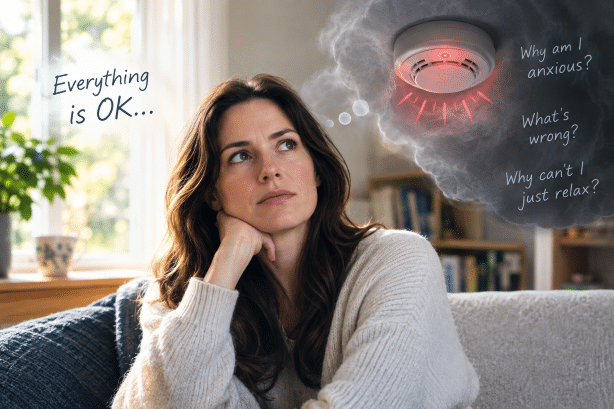
Why do I feel anxious for no reason when everything in my life seems fine?
It’s a surprisingly common question.
You look at your life and, as far as you can see, everything is OK. There is no obvious crisis, nothing particularly bad has happened, and there isn’t anything you can immediately point to and say, “That’s why I’m anxious.”
And yet you feel anxious.
Perhaps you feel restless or on edge. Maybe you can’t quite relax, thoughts keep running through your head, or you have that nagging feeling that something isn’t right. You might even find yourself asking:
“Why am I anxious when everything’s OK?”
And because you can’t find an obvious answer, you may start worrying about the anxiety itself.
Why am I like this?
What am I missing?
Why can’t I just relax when there’s nothing wrong?
The important thing to understand is that not knowing why you feel anxious doesn’t necessarily mean there is no reason.
It may simply mean that the reason isn’t obvious to you.
Why do I feel anxious for no reason?
We tend to think of anxiety as a reaction to something. Something happens; we perceive it as a problem or a threat. We become anxious.
That makes sense.
But what happens when nothing obvious is happening? You can quite genuinely look at your life and say:
“I’ve got nothing to be anxious about.”
Yet the anxiety remains.
This can be particularly frustrating because your conscious mind is telling you one thing while your emotional response seems to be telling you something completely different.
You may know that you’re safe. You may know that everything is OK. You may even know that your fears aren’t particularly rational.
But knowing something doesn’t necessarily resolve an emotional response.
And that distinction is important.
Knowing you’re OK doesn’t necessarily make you feel OK.
You can tell yourself:
“There’s nothing to worry about.”
“Everything is fine.”
“I’m being silly.”
“I need to stop worrying.”
Sometimes that helps…….. But sometimes it doesn’t.
If you’ve experienced this, you may already know how frustrating it can be. You understand logically that there is no immediate danger, but the anxious feeling doesn’t seem to have received the message.
You don’t choose to become anxious. And you can’t always choose to stop being anxious simply by deciding that you shouldn’t be.
So perhaps the question shouldn’t simply be:
“How can I stop myself feeling anxious?”
Perhaps there is another question worth asking:
“Why am I still producing this response?”
Turning down the siren isn’t the same as finding the fire.
Imagine that a fire alarm starts sounding in your house.
The first thing you probably want is for the noise to stop. You might press the button or otherwise silence the alarm. The house is quieter.
But you’ve achieved something vastly different from finding out why the alarm was sounding.
If there is a fire, turning off the siren hasn’t solved the problem. And if the alarm keeps sounding when there is no obvious fire, simply silencing it every time doesn’t explain why it continues to happen.
This can be a useful way of thinking about anxiety.
Managing the symptoms of anxiety can turn down the siren. But it doesn’t necessarily tell us why the siren is still ringing.
Learning techniques to calm yourself, changing how you respond to anxious thoughts or finding ways to cope when anxiety appears can all have their place. But they are concerned primarily with what happens when the anxiety occurs.
They don’t necessarily answer the deeper question:
What is causing the alarm to continue?
When did the anxiety start — and why does it continue?
This is an important distinction.
When someone develops anxiety, it’s natural to look backwards and ask:
“When did this start?”
Perhaps there was a particular event, or there was a difficult period in your life. Maybe you can remember a time when you first noticed the anxiety. That information can be useful.
But the beginning of a problem isn’t necessarily the reason the problem continues.
Knowing when something started doesn’t automatically tell you why it is still happening now.
Imagine that the fire alarm first went off because there really was a fire. The fire was dealt with. The house was repaired. Years later, the alarm is still going off.
Knowing what caused the first alarm to sound doesn’t necessarily explain why it is sounding now.
That’s why asking, “When did this begin?” may not always be the most useful question.
Another question may be more important:
“Why does this continue?”
Why am I anxious when nothing is wrong?
There may genuinely be nothing wrong in your life today. But that doesn’t necessarily mean that the reason for your anxiety has disappeared.
Something may have happened in the past that resulted in a particular emotional response. Circumstances may have changed, but the underlying reason for that response may not have been resolved.
Life moves on. The original situation may be long gone, but the response remains.
This can leave someone in the strange position of knowing that everything is OK while still feeling as though it isn’t. They’re not necessarily imagining a problem or overlooking something obvious, and they’re not just being irrational.
The response may have a reason that simply isn’t available to conscious thought.
The difference between managing anxiety and resolving it.
There are many ways of managing anxiety.
You can learn techniques to calm yourself. You can learn to recognise anxious thinking. You can change the way you respond when anxiety appears. These approaches can be useful, particularly when someone needs help dealing with anxiety in the moment.
But there is an important distinction between managing a response and resolving the reason for the response.
Going back to our fire alarm, managing the symptoms can be like turning down the siren. The noise becomes less intrusive. You may feel calmer. You might become better at coping with the alarm when it sounds. But that doesn’t necessarily tell you why it keeps ringing.
And if the underlying reason for the alarm hasn’t been resolved, you may find yourself needing to manage it again and again.
Curative Hypnotherapy asks a different question:
Why is the alarm still necessary?
You don’t necessarily need to find the event that started it.
Another common assumption is that resolving anxiety means finding the original experience and understanding exactly what happened.
Sometimes that can be important.
But the event that started something isn’t necessarily the thing that is keeping it going. You can know exactly when your anxiety began and still not understand why you remain anxious today.
This is where I think the distinction between when and why becomes particularly important.
Looking for when takes you back to the start of the symptom.
Looking for why takes you underneath the symptom.
And if the aim is to resolve rather than simply manage the problem, that distinction matters.
Why would your mind continue producing anxiety?
This is where things can become more complicated. Your conscious mind can quite reasonably say:
“Everything is fine.”
But an emotional response doesn’t necessarily operate according to the same conscious reasoning.
There may be associations, expectations or unresolved experiences that continue to influence the response without you being consciously aware of them.
This is one reason why someone can say:
“I know there’s nothing to worry about. I know I’m safe. But I still feel anxious.”
They aren’t necessarily failing to understand their situation; they may understand it perfectly well.
The difficulty may be that understanding something consciously isn’t the same as resolving whatever is producing the response.
What if the anxiety no longer had a reason to be there?
This is the fundamental idea behind a curative approach.
Rather than concentrating solely on how to respond when anxiety appears, Curative Hypnotherapy looks at why the response is still being produced.
The aim isn’t to pretend that anxiety doesn’t exist, and it isn’t simply to teach you how to become better at living with it. It is to explore what is underlying the response and why your mind continues to produce it.
Because if the underlying reason can be resolved, the response may no longer need to be there in the same way.
Going back to the fire alarm:
Managing anxiety turns down the siren.
Understanding the problem identifies why it is ringing.
Resolving the underlying reason means the siren no longer needs to keep sounding.
That is a very different objective.
So, why am I anxious when everything’s OK?
Perhaps the answer isn’t that there is secretly something wrong with your life – perhaps there isn’t.
Your anxiety may not be a response to something happening now – it may be the continuation of a response whose underlying reason has not been resolved.
This offers a different way to view the problem.
Instead of asking:
“What should I do when I feel anxious?”
or:
“When did my anxiety start?”
perhaps the more useful question is:
“Why does my mind still believe I need to feel anxious when everything is OK?”
That is a totally different question.
And sometimes, finding the answer to why can be more important than learning how to manage what.
If this sounds familiar
If you regularly feel anxious even though you cannot identify anything in your life that should be making you anxious, it doesn’t necessarily mean that you’re missing something obvious.
And it doesn’t mean that you’re simply incapable of relaxing.
There may be an underlying reason for the response that isn’t immediately apparent to your conscious mind.
You don’t necessarily need to spend the rest of your life learning how to manage anxiety.
Sometimes the more useful approach is to understand why your mind continues to produce it in the first place.
Because turning down the siren can make things quieter.
But finding out why it is still ringing is a vastly different thing.
So, what next?
The Anxiety / Fear / Nervousness page of my website explains more about how Curative Hypnotherapy can help.
When you want to organise your first appointment, just use one of the following ways to contact me or use the ‘Book Online’ facility.
Call or Text – 07380635523 / email / Chat
